Greetings, travelers. I’m a huge sucker for a great short story, and grabbing a bunch of them in one place feels like stepping into different worlds—or different parts of the same one. I especially love when there feels like there’s some connective tissue there, and in the case of the book we’re going to be talking about, all of these things fall into place in the perfect way.
We’re going to be talking to author Georg Ambeeke, who is the writer behind Tales of the Hawk Forest, an anthology that has the forest sort of at the central point, although what really binds these tales together is their ability to make the reader weave their way into introspective thoughts. If you’re looking for stories that make you think about how you see the world, read on to see our conversation with this talented storyteller.
Tellest: Greetings, Georg! Thank you for taking time to illuminate the forest and discuss these tales you’ve worked on. I’m excited to walk the path and to see elements of your writing process, and how you came to blend storytelling, ethical questions, and the study of the human experience into what you do!
Georg Ambeeke: Thank you very much for inviting me to my first interview, as far as I can remember. My motivation for writing the six short stories varied somewhat. “The Witch with the Donkey Ears” stands out a bit from the rest. It was meant to be just a children’s fairy tale for my daughter in the style of the Grimm fairy tales, but it came a little too late for her and ended up in the anthology. While “The Witch with the Donkey Ears,” “Astraea,” and “The Two Brothers and Death” are purely fictional stories, the other three stories have autobiographical elements. Autobiographical in the sense that they were inspired by my own very unpleasant experiences, such as exclusion (“Lazy Albert”), being exploited and betrayed (“The Lifeclock”), or being different (“The Oddball”).The fact that there is a positive message at the end will hopefully encourage us never to give up hope, no matter how dire the times may be.
When, like me, you’ve been observing the world for over 60 years, doubts arise as to whether everything we do is truly right and whether the world might not be much better if we did this or that differently. Above all, there is always the search for the meaning of life. Then the question arises: how do you share such insights and life experiences with others? No one will want to read a list of all the evils in this world, and it probably won’t motivate anyone to change anything. So, I’ve picked out various points and packaged them into (hopefully) engaging stories or parables
T: So, one of the things that I like to do to sort of calibrate these interviews is to figure out the earliest point at which you might have fostered your creative spark. When it comes to storytelling and imagination, did you have someone that you believe inspired you, like a favorite author or other creator? Or were there people in your family that had a penchant for storytelling?
GA: I was creative even as a child, but writing wasn’t really my thing. Since I also did very poorly in German class—my native language—at school, my father, who was a German teacher himself, made me read several books, which I did only very reluctantly. I never had the time to read a thick novel from cover to cover. To at least appear somewhat cultured—and because I was actually interested in them—I watched the film adaptations of many novels. That way, I was usually done in 90 to 120 minutes. A thick Shakespeare play would surely have taken me weeks, and by the end I wouldn’t have known what it was about because I would have long since forgotten the beginning. The only books I found worth reading were technical books, mainly on electronics, because electronics tinkering was still a very widespread hobby in the 1970s. That’s how it came to be that, during that time, I published several articles for assembly instructions in renowned German electronics magazines for the first time.
After that, I didn’t publish anything for nearly 20 years. Military service, college, and starting an engineering firm left me with hardly any time for writing. To get back to your question: No one in my family was interested in writing stories. I also never got to know any authors personally. That’s why it took me a very long time to imagine that anyone might be interested in reading a book I had written. Still, around the turn of the millennium, I wrote two technical books on CRT monitors and switching power supplies. Through years of working with such devices, I had gained a solid knowledge base in the field. The books were very popular among insiders, but because of the very limited target audience, you couldn’t really get rich from them. Besides, the technology described—especially regarding CRT monitors—was so outdated after just a few years that nobody needed the books anymore.
Although the subject matter of *The Power Supply Book* was still very relevant, the hardcover edition was already seven years old following the liquidation of my old company and would have needed a thorough revision. On top of that, the distribution rights were unclear. Since I wouldn’t have been able to make any money from it anyway, I published a freely accessible online edition so that I could continue to offer the book to interested readers. Interestingly, thanks to the promotional effect of the free edition, I earned significantly more money with the online book in my new company than I had previously with the hardcover edition.
It was also during this time that I made my first tentative attempt to write my own story, which I still haven’t finished to this day. My main motivation was that many stories—or rather, their film adaptations—are completely at odds with reality in terms of technology, physics, or logic. I believed that it must also be possible to tell a story in such a way that the laws of physics—which I know quite well as an engineer—are at least largely adhered to.
After some turbulence (buying a house, starting a family, winding up a company, and founding a new one), I resumed my writing career around 2010.
T: As an engineer, you’ve got a finger on the pulse of technology. While there’s definitely some semblance of sci-fi in this collection, it leans more fantasy. You mentioned wanting to work on a sci-fi trilogy. How does it feel moving on from the forest to work on something a little more grounded in technology (whether it’s fiction or fact).
GA: The first part of the trilogy also begins in the forest, partly set in a medieval, fairy-tale-like fantasy setting. However, the technological level of the story rises steadily and, by the end of the first part, exceeds today’s state of the art, depending on when I publish it. In the second part, it will definitely take on an extraterrestrial and futuristic tone. I find the blend of fantasy elements and science fiction fascinating.
T: So, we’ve only got a brief snapshot within that trilogy where we get to see the technology of the near future being represented. It sounds, then, like you’ve got your eye on a more distant boundary. When you’re imagining that, what kind of technology do you think we’ll be immersed in? Will we turn a point where technology feels like it’s being used for good, or will there still be people utilizing it for nefarious purposes?
GA: The idea for this story is now over 15 years old. Since AI plays a major role in the story, I would say, from today’s perspective, that current technological developments have already rendered the story obsolete. I may have to make some adjustments. But that’s not such a big deal, because the story isn’t primarily about the technology itself, but rather about the way the protagonists use and experience it. As is so often the case in my stories, it deals with philosophical and existential questions. But I can’t reveal too much about it yet, as long as the book hasn’t been published and the copyrights aren’t secured. Otherwise, someone might snatch up the idea, maybe even make a movie out of it, and if I want to publish my book, I’ll be sued for plagiarism. I can say this much: In the first part, the technology leads to a revolutionary development that makes dreams come true, but could also be frightening and unsettling for many people. But that was already a spoiler, so you’d better forget it before the book comes out.
The second part then also deals with the dark side of this technology
T: Since a good deal of what you like to write is about the human condition, you tend to write with a sense of realism. When it comes to the more fantastical elements, do you find them challenging or does it come as a sort of breath of fresh air to write outside of your comfort zone?
GA: This is less of a challenge and more of a way to lighten the mood when discussing abstract technical topics. I hope that this makes the stories accessible even to readers who aren’t particularly tech-savvy. Perhaps people’s inclination toward the mystical is genetically ingrained.
T: You mentioned earlier writing technical manuals, so you’ve had the writing bug one way or another for a long time. If you weren’t writing fantasy or sci-fi, is there some other speculative fiction you could see yourself playing in? Do the paranormal or horror genres call to you at all?
GA: I’ve actually thought about that, but there are probably plenty of authors who can do it better. For me, paranormal themes would always end up being explained away scientifically anyway. I don’t really get much out of pure, gory horror without any deeper meaning. Maybe I could warm up to more subtle forms. When it comes to science fiction, I certainly have a technical advantage, and when it comes to philosophical topics, my advanced age isn’t a disadvantage either, especially since I’ve always been a quiet guy, but an interested listener and observer.
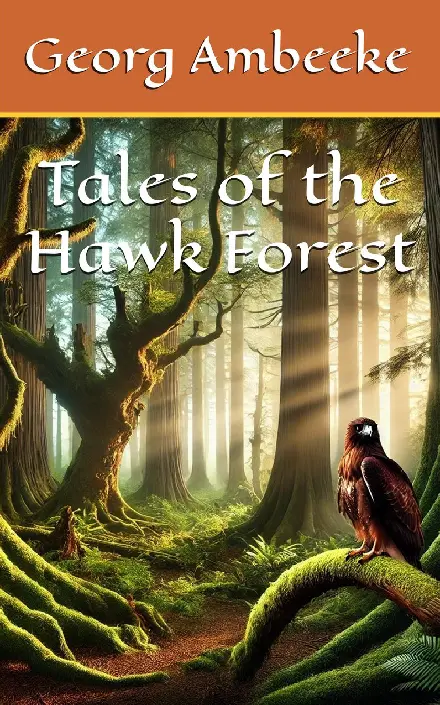
T: We’re going to be talking about an anthology that you put together and released across a few months in 2025. Let’s briefly talk about Tales of the Hawk Forest as an anthology collecting these tales, and then we’ll get into some of the individual stories to get a bit deeper into the trees. When did you know that you were going to be putting these shorts together into one package? And was the forest always the idea of how you were going to be connecting them?
GA: The idea of compiling the stories into a book didn’t really come up until around 2024. At first, the plan was to publish each story individually, which isn’t a problem with an e-book. However, Amazon KDP recommends also publishing a paperback, which doesn’t make much sense for a short story. That’s why, in 2025, I decided to also offer an anthology as an e-book and a paperback. As far as I can remember, the Hawk Forrest didn’t come into the picture until around 2024. This isn’t just any forest, but a place full of myths and legends. I’ve often hiked or cycled there. This forest is simply mysterious and inspiring. The Brothers Grimm also spent most of their lives in my hometown of Kassel (Germany), right on the edge of the Hawk Forest (Habichtswald), and collected many of their fairy tales right here in and around the Hawk Forest. Since I also live right next to the Hawk Forest and the stories are mine, they are, in fact, Tales of the Hawk Forest. That is the essential commonality. But I don’t want to take credit for someone else’s work, which is why I didn’t mention it in the books.
T: Things are definitely a bit more magical within your glimpses of the forest, but they’re also allegorical, and you like to speak your stories into existence with a bit of a message. Not everyone agrees with one’s personal philosophy though. Have you encountered any pushback since releasing these tales?
GA: So far, there hasn’t been any open criticism. There have been a few notably poor ratings on Amazon, but without a detailed review, we can only speculate about what these readers didn’t like.
T: Let’s talk about the individual stories a bit more here. You have six tales that bring this collection together. Which was the first one that you worked on? Was that your first story ever that you committed to page? What inspired you to bring that to life?
GA: The work on the stories overlapped in time. That’s why I can’t say exactly in what order I wrote them. “The Lifeclock” and “The Witch with the Donkey Ears” were probably the first ones, and “Lazy Albert” and “The Oddball” were likely the last.
Around 2010, I started working on a science fiction novel that was planned as a trilogy. The first part is already finished, the second still needs a thorough rewrite, and the third is only in the planning stages. But then I realized that as an unknown author, you hardly have a chance of getting something like that onto the market. That’s why I’ve put this book project on hold for now and am trying my hand at this anthology first.
T: You mentioned earlier that one of your stories was intended to be a children’s story for your daughter, but that she sort of outgrew it as it was intended. What does she think about that story now that she’s a bit older? What about the rest of your family? How do they feel about your tales coming to life?
GA: That’s an interesting question. My own family shows very little interest in the stories, and I didn’t even tell my relatives about it, just to be on the safe side. My daughter has always said she likes the fairytale, but that doesn’t exactly sound like wild enthusiasm 😉 Perhaps that was to be expected, since this problem has been known for about 2,000 years:
A prophet is not without honor except in his own country, among his relatives, and in his own house.
T: That is a good point. You don’t know if you’d get legitimate feedback from your family if you were to canvas them for an opinion.
Shifting gears then, have you had an opportunity to get your stories in front of anyone that you’ve known or met, and received legitimate feedback from them? This could be anything from someone online, or someone that you met at a live event like a reading or a convention.
GA: Yes, this experience is a bit frustrating. At home, you’re a family man, a provider, or a handyman, but after so long, no one can imagine you as a serious author anymore. Since I don’t know any bookworms and have no other connections to the writing community, I was pretty much on my own. The only people who really read through the texts were the editors, who thought the stories were pretty good. I also had ChatGBT read through the stories and received very good reviews. I’ve published those on my website, by the way. But you shouldn’t overestimate them either, and in that sense, the publication was a leap of faith and also risky. If the first readers turned out to be the very people who didn’t like the stories at all, there would be a barrage of bad reviews, and the stories might never reach their target audience.
T: Which story in this collection is the one that you think is your favorite? Which one do you think will be the one that readers will cling to the most?
GA: My favorites are “The Lifeclock” and “The Two Brothers and Death.” “The Lifeclock” has already received some good reviews in the German version and seems to be well-received. As for “The Two Brothers and Death,” there appear to be only a few brave souls willing to tackle this sensitive topic. It’s quite possible that this story leads to insights that are too unsettling for some people. But those who give it a chance might come to see life from a completely new perspective.
T: Philosophical studies are interesting in that because they’re so nuanced, they end up being more of a release for the storyteller than the readers in some cases. How would you say you’ve accomplished writing something that bridges the gap between something like that and a story that’s more written “to market”?
GA: I hope I’ve actually succeeded. Here’s my reasoning: I’m a fan of mystical and magical fantasy stories, regardless of my affinity for technology. Many of the well-known stories in this genre have been adapted into films—some even multiple times—which leads me to conclude that there must be a large fan base for them. This means that my taste for such stories seems to largely align with the general trend. So, I come up with a story that suits my taste and hope I’m on the right track. Only then do I incorporate the philosophical elements into the stories.
T: You mentioned stories within speculative fiction being adapted into films, and that leads me to one of my favorite questions that I get to ask storytellers. Would you enjoy seeing your content in other mediums? Whether it’s the shorter stories within the anthology, or something bigger like your upcoming trilogy, would you like to see them on screens big or small in some way, or even in something like a graphic novel or comic?
GA: That’s a very good question. I prefer live-action films or funny comics, but I could also easily imagine reaching my target audience through other means, such as audiobooks.
I’ve seen plenty of movies in my life whose stories have disappointed me, and by the end of the film, I’ve found myself thinking about what interesting stories could have been made from that material. Then, of course, at some point you start thinking that you could have done it much better. In my opinion, many stories far worse than mine have been made into movies. In that sense, I could definitely see at least some of the stories being adapted for the screen. But since I have no connections in the film industry, as a relatively unknown author, I’m unlikely to be taken seriously.
T: These stories aren’t ones you’ve written just for entertainment purposes, but really to help people open their minds and realize what it is they’re doing. What kind of messages are you trying to help convey to people, and which of these stories do you think best encompasses that pursuit?
GA: I can’t really say that simply, because every story has a different focus. However, on my website I’ve listed quotes from the stories, some of which represent the central message of the stories quite well.
“The Witch with the Donkey Ears” is simply a classic-style fairy tale in which good triumphs over evil. Quote: “What kind of a world would it be if evil always triumphed?”
“Lazy Albert” deals with the sense and nonsense of community service, especially when you try to force people to do it. Quote: “What good does it do if the baker spends his time harvesting instead of baking? Then everyone ends up going to work hungry.”
”The Lifeclock” is about the search for happiness. Quote: “A lifetime of happiness is just around the corner. You just have to open the right door, at the right moment.”
“Astraea” addresses the question of whether humanity is worth saving from an impending apocalypse. Quote: “From a scientific point of view, people are still very underdeveloped. Not only do they spout a lot of nonsense, but they also believe any nonsense they are told.”
“The Two Brothers and Death” is about nothing less than the search for the meaning of life. Quote: “For the body, the journey ends in the grave, whatever form that may take. But if a person has built bridges to the future while they lived, their spirit can cross time and cast light into every corner of the world. Without those bridges, the trace of a life quickly vanishes into the mists of time.” Perhaps a bold thesis. On the one hand, it’s frightening, but on the other, it’s meant to motivate you to make something of your life.
“The Oddball” deals with the problems, but also the advantages, of being different. Quote: “How, Roland wondered, was anyone supposed to convince an employer that they were more suitable for an average job than all the other average applicants?”
T: Those quotes are very powerful. How did you find your way to getting them into the stories? Were the quotes developed first and the stories crafted around them, or did they find their form as the tales were being created?
GA: Almost all of the quotes have emerged over the course of the story. There was a quote—“People usually describe themselves when they speak badly about others”—that had somehow been left over, but I liked it so much that I absolutely wanted to include it somewhere. It has now ended up in “The Two Brothers and Death.” But I’m not 100% happy with this placement either. Perhaps inserting a quote after the fact isn’t entirely authentic.
T: But I do think because it’s got a philosophical undertone to it, you’re better equipped to sort of splice it into place than most.
But you did mention something in there about a quote that dropped out and found its way somewhere else. Have you had any characters or events within your stories that have tried to inspire another story elsewhere?
GA: Yes, I hope I’m able to do that.
I put my first story from the turn of the millennium on hold because it strayed too far from physical and technical reality, but it inspired the first part of the trilogy, which works within the limits of today’s technology. I find science fiction stories much more compelling when you know they could actually happen here and now.
The first part of the trilogy was also an inspiration for the story “The Two Brothers and Death,” though of course only in a philosophical sense. When the first part of the trilogy is hopefully published someday, readers familiar with “The Two Brothers and Death” will find quite a bit that feels familiar.
T: Now that these six tales have been out for nearly a year, have you begun working on anything to follow? Is there another anthology that might be waiting in the wings? Does it take place in the forest, or is there another way that you might connect those stories?
GA: I actually have two more stories in the works. But it will be a while before they’re finished. I still have to earn a living doing other work, so unfortunately I don’t have much time for writing right now. Maybe I’ll have to hire a ghostwriter 😉
The stories won’t necessarily take place in the forest, but they’ll be set there—or at least within sight of it.
T: You said that you had started up another company, and that’s got to be plenty draining. When do you find time to express your creativity these days?
GA: The most difficult part was the collapse and liquidation of the old company, but fortunately, I got through that after a few years. Because of that bad experience, I decided to work only on my own from then on, in my own home lab. Thanks to the positive financial performance of my new company, I also had a little more freedom to pursue other activities. By the way, I incorporated these life experiences—along with a few magical ingredients—into the story “The Lifeclock.”
T: A lot of storytelling is writing what you know, but with speculative fiction, we get to explore the unexplored as well. Sometimes that means researching, developing ideas, etc. One is definitely easier than the other. Do you have a preference as to which space you’re playing in?
GA: I avoid writing about things I don’t know anything about. For example, I wouldn’t write a crime story. To do that, I’d first have to familiarize myself with the basics of police investigative work. I simply wouldn’t have the time for that. I take the same approach here as I do in my profession: I sell my clients what I can do better than others. What others can do better, they should do. From that perspective, I’d mainly have to write science fiction stories. However, when you grow up in a place where fairy tales are everywhere, you might also be born with a bit of magic and philosophy in your blood 😉
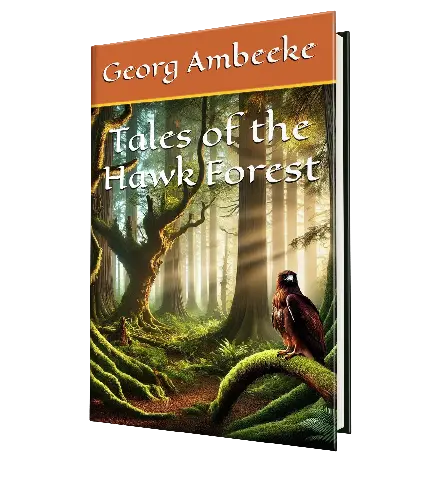
3D version is for mockup purposes only. Currently only on sale as an eBook and a paperback.
T: Folks who read your anthology are likely going to want to see more from the forest, and more from you. When you have more stories out, do you have a place that you’d want to direct your fans to? Do you have a website or a social media account that you would recommend they look at?
GA: To that end, I’ve launched a website where you can find more information about the stories: https://www.ambeeke.de/startEN.html
You’ll also find the collection of quotes I mentioned earlier there. If there’s any news about the books or new stories, I’ll post it there.
T: Georg, I wanted to thank you for sharing some of your time with me and with your readers in order to press the branches out of place long enough to find a clearing in the forest. The view from in here was very interesting, and I really enjoyed seeing where your journey started, and getting an idea of where to expect you’ll go next. I hope you had a great time revealing some of how you arrived here, and I also hope that your readers feel a bit closer to you and your work after having followed along with this interview!
GA: Thank you too, Mike, for giving me the chance to share a bit about myself here. I really enjoyed it, and I had to rein myself in so my answers wouldn’t get too long-winded. I hope this will attract even more readers who are willing to engage with the stories, perhaps gain new insights, and—if all goes well—help create a better world one day. I think there’s no doubt that this is urgently needed.
To wrap things up, here’s a fitting—albeit tongue-in-cheek—quote from *Astraea*:
“Unfortunately, it is still not advantageous to be a good person these days, but in a thousand years this might be different. If this does prove to offer a real advantage in life, there will certainly be many more good people. However, people’s usual criteria for choosing a partner would have to be fundamentally revised”
T: I’d like to once again thank Georg Ambeeke for joining us here in the Otherworld to discuss his anthology, Tales of the Hawk Forest, as well as the stories within. It’s always a blessing being able to find time carved out by busy storytellers, and to learn more about them and how they came to express their work in the written word. If you’re looking for the author’s very entertaining anthology, check out Tales of the Hawk Forest on Amazon today!


Michael DeAngelo
Latest posts by Michael DeAngelo (see all)
- Historical Fantasy Promo – Under the Black Ensign: A Pirate Adventure of Mutiny, Freedom and High-Seas Action - October 1, 2026
- Sci-Fi Promo – DISCONNECTED: A Prison. A Paradise. Two Souls. - September 29, 2026
- Dark Fantasy Promo – Ascaron: Ad Vocatus, part. 1 - September 25, 2026