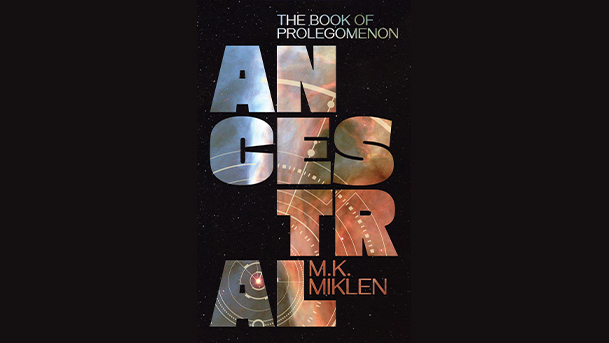
Greetings, travelers. It’s always a great time getting to know a new author, but most of the time we’re forced to form our opinions of them just in what we read of the material they grace us with. Here at Tellest, we can pull back the veil and get glimpses of the storytellers in action.
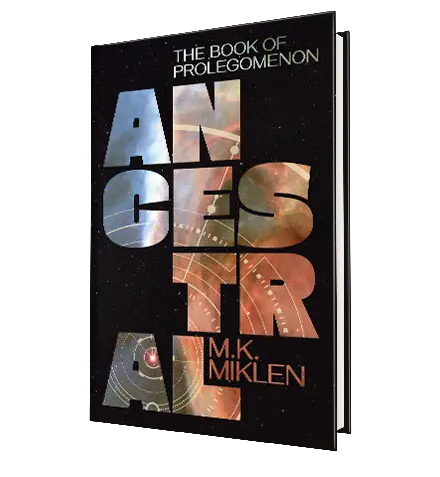
Today, we’re going to be talking to author M. K. Miklen, whose science fiction epic, Ancestral, has launched just several weeks back. While you should absolutely dive into the fantastic story, you should also take a little bit of time to float here in the safe space and learn how Miklen came to their ideas, to see what drives them, and to see what comes next.
Tellest: Greetings, MK! I wanted to thank you for carving out some time from what looks to be a pretty busy creative schedule (which we’ll for sure be talking about later). I’m excited to learn more about what brought you here, and where you expect to go now that your debut book has launched. I’m also sure your readership and fans, like me, are interested in knowing what your process is like. It’ll be fun to learn more about you.
M. K. Miklen: Greetings, Michael, and thank you for the opportunity to speak to your readers.
What brought me here is the need to tell stories. It’s really as simple as that. I’ve always been a devoted fan of fantastical worlds and I love getting lost in them, whether through books, films, TV series, comics, or video games. I enjoy exploring new worlds and ideas and letting them carry me away for a while.
Over the years, my imagination never stopped creating stories of its own. Eventually, it felt natural to move from being a fan to becoming a creator myself and to contribute something of my own to a genre that has given me so much.
I believe every story has its own journey, and I hope Ancestral will have a long one, reaching as many readers as possible. When I write, I try to keep one thing in mind above all else: honesty. I try not to rely on clichés or easy solutions, while holding on to the same sense of wonder and curiosity that first made me fall in love with science fiction.
In many ways, my guiding principle is simple: I don’t write what I want to write. I write what I want to read.
T: That is a fantastic principle to stand by. It’s good to have a marketing target in mind!
One of the first questions I like to begin with when it comes to interviews like these is one that speaks to the foundational layer of a storyteller’s creativity. To that end, do you remember a favorite author or comic book writer or director or anything like that which might have lit a spark in you? Or was there perhaps someone in your community who took up that role?
MKM: That’s a great question because I think every writer is, in one way or another, a product of the stories they grew up with. We all carry those influences with us, whether we realize it or not.
Growing up in Eastern Europe, I often looked at British and American science fiction as a gateway to bigger worlds and bigger ideas. Those books represented a kind of freedom of imagination that fascinated me. It’s probably no surprise that some of my biggest influences are Peter F. Hamilton, Alastair Reynolds and Neal Asher. Their sense of scale, ambition and worldbuilding had a huge impact on me as a reader.
At the same time, I never limited myself to science fiction. I read fantasy, horror, graphic novels and pretty much anything that tells a compelling story. What attracts me most is the freedom these genres offer. They allow writers to explore ideas that would be difficult to approach in any other way.
More than anything, I admire authors who follow their curiosity wherever it leads. The stories I remember most are usually the ones that feel alive, as if the writer is discovering the world alongside the reader.
T: That gives us a nice segue to talk about how you write your stories. When you’re playing in the worlds or universes you’re building, do you see that discovery as something like walking into a portal into another realm? Or is it more like unearthing an ancient relic and seeing it in your mind’s eye in a more lifelike situation. Or is your interpretation something much different entirely?
MKM: I think it is a little bit of both.
First, I step through a portal into another world and try to establish its rules and principles as clearly as possible. Once those foundations are in place, I do my best not to break them. No matter how strange a world may be, it needs an internal logic.
Once that logic exists, the process becomes more like archaeology. I begin exploring the world as if it were an ancient artifact waiting to be uncovered. Like a fortunate archaeologist, I start digging, hoping to reveal something special: an object, a city, or perhaps an entire civilization. How much I discover depends largely on how deep I am willing to dig.
I think that once the rules of a universe are well defined, the world begins to take shape on its own. At that point, my role is often to accept or reject what emerges, to refine it, expand it, or subtly alter it where needed.
Then comes the part I enjoy most: breaking the routine. Every good story needs moments that disrupt expectations. Even the strangest worlds benefit from the presence of something unexpected, something that feels slightly out of place or difficult to explain. Those anomalies create mystery and curiosity. The important thing is that they still respect the underlying rules of the world. They may challenge what we know about it, but they should never contradict the foundations it was built upon.
T: It took a lot not to ask this question first. Those who know me will no doubt understand that I’ve got a problem with naivete, so if so if this is just part of the author “character” you’ve concocted, don’t mind me, but it seems you’ve grown up in Transylvania. Is that correct?
MKM: Oh yes! That is no gimmick. Born, raised, and still a resident of this haunted land. And I enjoy every moment of it.
T: Does a place like that, which is so enshrined in legend and lore as well as very, very popular fiction, help to kind of liberate an active imagination? Or does it almost feel more imposing hanging over you if you live there?
MKM: I’m going to disappoint you there, Michael. We vampires and werewolves have an unwritten rule that has been passed down from generation to generation: whenever someone brings up our dark past, we are required to treat it with irony and ridicule. It’s the best way to keep unwanted curiosity at a safe distance.
I’m afraid I can’t reveal much more than that, otherwise I’ll have to answer to the Grand Conclave.
On a more serious note, these lands bear the marks of the countless traditions and influences left behind by the many peoples who have passed through them. Being situated at the crossroads of so many great empires and cultures has created a unique artistic and creative outlook that carries traces of all those different sensitivities and ways of thinking.
Perhaps we are not the best of all worlds, but we have certainly learned to understand many worlds at once. I think that can be seen in Romanian culture, art, and literature.
In my own case, I hope to bring a little of that perspective into science fiction. If nothing else, I hope it allows me to contribute something that feels a little different.
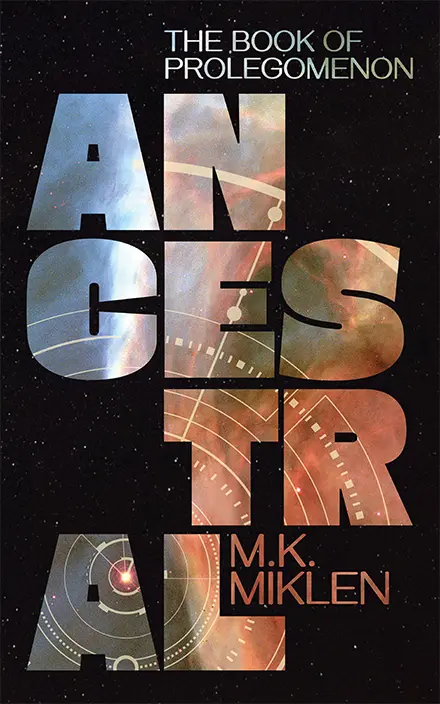
T: Moving on, I would be remiss if I didn’t bring up the story that we all want to know more about, and that’s your debut, Ancestral: The Book of Prolegomenon. How did that book come to be? What was the inspiration for it?
MKM: My story began with a mischievous idea about two human civilizations, lost in different parts of the universe, each following its own path until they eventually meet again in a conflict of annihilation, without recognizing each other anymore.
I played with that idea and it slowly turned into something much larger, expanding into different directions as I built it from the ending backward. That is how the story started to take shape.
It became a bittersweet story that answers that initial question while raising many others. It is not a trick meant to keep readers going until the final pages, but rather the point where everything is meant to come together. At least that was my intention. It is the kind of story I would enjoy as a reader, one that stays with you long after you finish it and makes you think about its consequences and implications.
To be less cryptic, let me quote the first line of the book’s blurb: “This is not just the story of a few. This is the story of us all.”
I wanted it to be an epic story built around one of the biggest themes I can think of: the fate of humanity, its place in the universe, and its origins. Because of that, I felt it needed to be told through simple, believable characters, people like us.
When I first started outlining it chapter by chapter, I realized that any other approach would not have felt natural. This was simply the way the story needed to be told.
Along the way, I also paid tribute to the writers who influenced me between the lines, and I included a few of my own guilty pleasures.
T: Ancestral is a sturdy book. It’s got a great amount of narrative heft to it, yet it never feels like it’s padded or exposition heavy. Did you realize as you were writing it that it was becoming a pretty substantial debut?
MKM: I wanted a strong debut, so I didn’t hold back on either the words or the concepts. During editing, however, I started cutting. I followed advice often associated with Stephen King and removed anything that didn’t feel essential to the story, or anything that felt like it existed more for me than for the reader. I’m glad I did that.
What remained is a book that, I think, breathes well. It alternates between tension and harder science fiction ideas and lighter moments of relief, without ever letting the reader feel entirely safe. I chose to present the world through the events themselves, letting it be discovered rather than explained directly.
It is still a substantial novel, but I don’t believe there is anything extra or anything missing in it.
T: The blurb is quite cryptic. Is there anything else the reader should know about Ancestral? What is the biggest misconception a reader might have about the book after reading only the blurb?
MKM: The blurb, although cryptic and perhaps even bold at first glance, is an honest one. It is simply the general idea, told in a certain way. But behind it there are characters I have grown to love, some climactic moments that I hope will keep the reader on the edge of their seat, some new and interesting scientific and technical concepts, and some images that I hope will haunt the reader long after they finish the book.
But before anything else, everything comes down to characters and how alive they feel. At the center of it all is a young woman named Elsie, who starts the story as a victim of unfortunate circumstances, whose fate is always hanging in the balance, with only one reliable ally by her side: the reader. Then there is Durante, a soldier who found a family in his comrades, but is about to lose it when the powerlessness of having no real choice catches up with him. And there is an admiral whose decision-making defies ethics, in a way that feels uncomfortably familiar. I wanted all these characters to be simple and vulnerable, yet complex and powerful at the same time.
I have often asked myself: what age and what audience is this book for? I came to the conclusion that although I often use the irony of naivety to express certain flaws of society, it is not a book for teenagers. I use elements of advanced astrophysics without turning it into a pretentious hard SF novel. I blend bloody battle scenes and sex with psychological trauma without targeting any particular age group.
I believe it is a book for anyone who is open to an honest read that doesn’t try to be pretentious, and that aims to celebrate the genre more than anything else.
T: You mentioned being glad that you removed those non-essential pieces of the story. Was there any part of you that was disappointed to be losing some of the things that were left on the cutting-room floor? After all, a big piece of King’s recommendation is to “kill your darlings.”
MKM: Not really, because I found a solution that I think became more fitting. All the worldbuilding elements I treated with a calculated indifference that might seem a little irreverent, but I believe it suits the story best as a fitting frame for what I wanted to convey. I chose to push the narrative mostly toward an investigative style rather than a panoramic approach, which creates even more intensity and mystery.
Besides, I hope the story pulls me back to its world someday, where I can revive the darlings I once killed.
T: In your “About the Author”, you claim that you don’t see yourself as a writer and that playing in the universe of Ancestral allowed you to create and explore, and that it allows for things to be pushed beyond what we know is logical. In this first book, what was one of the things that you thought was stretched to that point?
MKM: I don’t really see myself as a writer in the traditional sense. For me, this started as something I enjoyed doing, without any pressure or expectations attached to it. Of course, I would love for Ancestral to reach as many readers as possible and to give them something meaningful in return, but at its core, the process has always been about enjoying the act of creating.
In Ancestral, I was interested in exploring both the human drive to move forward and the ways in which we often limit ourselves. The rules of the world we live in only take us so far, and science fiction and fantasy give us the freedom to go beyond that. They offer more space to experiment, and in doing so, to reflect on who we are and how we might evolve.
One of the ideas I worked with a lot was how far human understanding can stretch before something stops making sense in a traditional way. At a certain point, what we consider logic begins to break down, and we start to accept things that would once have seemed impossible.
In the book, I also worked with established hard science fiction concepts and pushed them beyond their usual theoretical limits, almost into territory that begins to resemble magic. Ideas such as modified black hole geometries or quantum entanglement applied to neural structures and consciousness models were particularly difficult to handle in a coherent way while still preserving internal consistency. But that tension between the scientific framework and outcomes that appear to violate it is exactly what made it compelling for me to explore.
T: How do you toe the line between hard science that appeals to people who enjoy the “science-y” part of the genre, and the sort of popcorn fun that some people who enjoy the genre are there for? And maybe a follow-up to that: do you think it’s possible to do both well?
MKM: I believe the science behind the story needs to be as realistic as possible without turning the novel into a dissertation. The reader needs to feel that the technical solution offered wasn’t pulled out of thin air out of laziness or superficiality, like a deus ex machina. And I notice this applies not just to science fiction versus hard science fiction but also to fantasy, for example, where the truly memorable worlds are built through magic systems that almost become technical manuals.
That said, it’s not necessarily a requirement, it’s an author’s choice. I personally enjoy elaborating because I love science and its challenges. At the end of Ancestral I also have an appendix chapter called The Science Behind, where I do exactly that separately, trying to justify my ideas without inserting info dumps into the narrative, and taking the opportunity to pay tribute to the people of science.
T: You have several different projects that you’re working on at this time, including a sequel to Ancestral, an anthology collection, and a grimdark fantasy. What would you say is the project you’re closest to completing?
MKM: Right now, the project I am closest to completing is a collection of five novellas. They are set in different worlds and explore different themes, and I plan to bring them together into a single volume.
Before returning to the next book in the Ancestral cycle, I wanted to step outside that continuity for a while and explore different genres and tones, from science fiction and fantasy to horror and even comedy. Each novella comes from a concept I found interesting enough to develop on its own.
Further down the road I also have a grimdark project in early development, as well as another Ancestral book. But at the moment, my focus is entirely on the novella collection.
I just hope the debut sparks enough curiosity for readers to want to explore more of what comes out of my imagination.
T: I have a few follow-up questions about the novellas.
You mentioned that they are a collection. Are you planning on putting them out as an anthology of sorts?
You also mentioned that they are set in different worlds. Is it different worlds in the universe, or is it different worlds in the multiverse? I suppose what I mean there is, are they all human-driven worlds that we’ll be exploring?
MKM: Yes, all in one volume. These are ideas, concepts and situations that I don’t want to develop into a full novel but I also don’t want to treat with the lightness of short stories, because I want to explore them more closely. So they will be 5 novellas, like a musical EP if you will.
They will be different worlds in the multiverse, meaning different areas and eras, with humans and not only. For example I’ll have a post-apocalyptic world where the animal kingdom redefines itself for post-human supremacy, a child whose dreams represent an escape into a ruthless realm, a comedy with hilarious characters when the worlds of SF and fantasy collide, some alien relics whose meaning, once uncovered, points to our own future, and an escape from a dystopian world that is already knocking at the door. Possibly a sixth one as well, though I haven’t sketched out a final version yet.
T: You mentioned earlier that you like to consume stories in a lot of different mediums. Have you ever envisioned any of the projects you’ve worked on to varying degrees in one of those mediums beyond the written word?
MKM: I think Ancestral would work really well as a graphic novel. And not just that it would work, but I would love to contribute to it myself as an artist, being a devoted fan of visual arts.
If I were to find a fitting game format I think it would be a classic linear FPS, something between Dead Space and Cyberpunk 2077, with the two main characters whose fates intertwine at the end.
As for screen adaptations, one can only dream! I don’t think there is a writer alive who doesn’t dream of that, however impossible it may seem, and I am no exception. I envision the first part of the novel in the style of Villeneuve’s Arrival and the second part more intense, in the style of Matt Reeves. Or why not a short animation in Love Death and Robots. I’ll take it for sure.
T: I have no doubt that people who end up reading Ancestral will want more from you and your literary universe. If someone wanted to know more about you and where to find your work, where would you direct them? Do you have a website or a social media handle that you prefer to steer them toward?
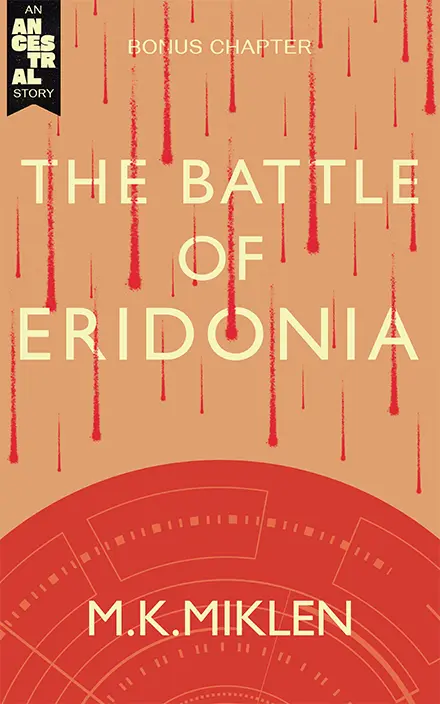
MKM: You can find me at www.mkmiklen.com, my author website. There I also have something extra for readers interested in the Ancestral universe, a free bonus chapter titled The Battle of Eridonia.
I am also on Instagram and Substack, though I am not very active on social media and tend to keep things fairly minimal there.
T: I wanted to thank MK for sharing their time in talking about Ancestral, about their process, and about how they came to stand where you do now. I’m very excited for them to expand their presence in the industry.
If you’re interested in picking up M. K. Miklen’s excellent debut, check out Ancestral: Book of the Prolegomenon on Amazon today!


Michael DeAngelo
Latest posts by Michael DeAngelo (see all)
- Historical Fantasy Promo – Under the Black Ensign: A Pirate Adventure of Mutiny, Freedom and High-Seas Action - October 1, 2026
- Sci-Fi Promo – DISCONNECTED: A Prison. A Paradise. Two Souls. - September 29, 2026
- Dark Fantasy Promo – Ascaron: Ad Vocatus, part. 1 - September 25, 2026