Greetings, travelers. When we take our trips into the Otherworld, we’re often presented with new worlds that have their own magic and majesty, or far-off galaxies that shine just a little differently than our own. They’re supposed to push us to the edge of imagination. But sometimes, the speculative fiction that we find keeps us close to home, twisting and contorting what we know into a frightening hellscape that we find ourselves caught within. And so, it is with the wildly talented Shaun S. Fitzgerald’s new work, Alone Together. It’s not your typical apocalyptic story, so if you want to know more about it, you’re in the right place. Read on to learn more about the author, his latest work, and a sizable catalog you might be missing out on!
Tellest: Hello, Shaun! First off, I wanted to begin by offering up my appreciation for carving out some time to discuss your work. You’ve got a growing catalog that leads me to believe you spend a pretty considerable time on your craft, so being able to chat with you even for a little bit is something that feels very rewarding to me. I’m excited to talk to you more about your process, Alone Together, and beyond, and I’m sure our readers will be as well!
Shaun S. Fitzgerald: Thank you for the opportunity to carve my name among the many talented writers you have listed. You are correct to assume I spend hours of my life behind a keyboard. My novels are just the front runners too. My website, ssfitzgerald.net has a collection of short stories, many which are set in the same universe of their respective novels. I also host a podcast, Birds with Words, which enables me to reach a broader audience and learn from other creatives.
T: So, pretty much every time I start off these interviews, I like to start from the same place. That would be trying to understand how you came to find yourself writing. I find that most often begins somewhere in our childhoods. Did you have a favorite author, or storyteller of some other medium whose art spoke to you? Or did you have someone within your family or community that seemed to stir something within you, creatively?
SSF: While I never thought to myself that I would be a novelist as a child, I knew I wanted to write a book. I think I could trace back my interest in storytelling to 5th grade. My teacher, Mr. Rose, was an amazing storyteller. At the end of each class on Friday, he told us this epic space opera for the last thirty minutes of the day. Years later, I discovered he didn’t come up with the story himself but was just giving us his verbal retelling of John Carter of Mars. When it comes to Alone Together, I think my interest in telling a post-apocalyptic story started in high school. My best friend and I spent countless hours consuming media from the greats like George A. Romero, and of course all the spin-offs he inspired, such as the 2004 remake of Dawn of the Dead and 28 Days Later.
T: Alone Together is a huge part of your catalog now, but I’m guessing it wasn’t the first story that you started formulating, and while we’ll be talking about some of the longer form stories in your catalog, I’m interested in some of the earliest tales you told. Do you have anything that you worked on that might not have made its way to the virtual storefronts, or a shorter story that pitched you forward and let you know that this path was for you?
SSF: I have a lot of manuscripts that I never moved forward with, and while I love those stories, I was correct not to push them out publicly. I tried writing a science fiction and horror story when I was entering my twenties. Elements of that first attempt showed up in Alone Together but not the story itself. The first book I wrote that I intended to publish, and didn’t, was a dark fantasy set in a steampunk universe similar to the United States in 1870. I loved a lot of elements from that attempt, and I think one of my secret projects will see elements of that story appear, but that’s a few years away. My short stories I publish to my blog on my website, I go back and touch them up and change minor elements until I feel comfortable putting them in the back of a hardcover. You can listen to the reading that’s recorded of Hunted, and you’ll see it’s a drastically different story from the one that is now written and published in the hardcover’s back of Sinner’s Pass.
T: Do you ever get in your head about going back and working on projects that you’ve released (either on storefronts, or on your website)? I know some people will suggest not to return to stories that are completed, but I’ve always been drawn back to mine, and like to touch them up and maybe even integrate new information from later in the series, etc.
SSF: It’s funny you ask this. February 13th, 2026, was a Friday the 13th, and I did a re-release of Sinner’s Pass. I touched up several scenes and expanded on a few key moments in the story. I also rewrote the short stories and included them in the hardcover release. The short stories were up on my blog for two years before I rewrote them. One of them changed so dramatically that it’s almost a totally different telling of the events now. You can see the difference by reading it and then listening to the old recording a voice actor did of it on my blog. My short stories, until they are printed in the back of a book or in an anthology, are fair game to be changed.
T: Let’s get into Alone Together. This isn’t your typical apocalyptic dystopian thriller. It sort of finds middle ground between your typical zombie stories and something along the lines of 28 Days Later. There’s real madness that drives these “infected” forward. What would you say was the impetus for putting together a story like this, and how would you say it differs from the stories that inspired it?
SSF: I teased you a little into this question with my media consumption in high school! Well, I never started putting words to paper. I didn’t want to tell just a zombie story. That’s been done, and by voices greater than I in the genre. I sat on this idea for years as I served in the United States Army. My last year was plagued by COVID, which greatly shaped the way I thought about the telling of Alone Together. With my experience buckled down, I reread some of my favorite adjacent stories, The Andromeda Strain and DUNE, and The Remaining series. I don’t want to give too much away, but we’re not dealing with zombies or even “infected,” though that may be how it all starts. Think of the initial outbreak as a symptom to a greater change in our world.
T: Let’s talk about what the name of your book and series means. Post-apocalyptic stories will typically use whatever caused the dystopia as a backdrop, but the real study is on the people. What messages are you trying to send about community, survival, and rebuilding?
SSF: I think Josh from Already Overbooked hit the nail on the head when he said Alone Together explains the isolation that can happen even when you’re surrounded by people. Yes, there’s the surface-level isolation that the characters are experiencing, but the emotions of loss can isolate people even while working their daily jobs. We are introduced to characters that have pre-existing traumas and ones that experience trauma for the first time while trying to survive, and I bring those thoughts and feelings to the forefront. Characters can’t just be killed off, these characters are fathers, mothers, sons, and daughters. That leaves a ripple across the other characters.
I also wanted to break some perceptions of the military that Hollywood and other media paint the military during such world-changing events. I present my military characters and the situation they find themselves in, with the real-world limitations I found when I served. At the same time, the military is far from incompetent. I created this calamity around justifying how such an effective fighting force would find themselves on their back heels fighting for their lives.
T: You do a wonderful job of making the characters feel complete. They’re not just developing as the story goes on, they’ve got a whole rich backstory that informs their choices and their mental state. Do you think that there’s a reason that you’re able to tap into that so well?
SSF: I’ve had the privilege of serving with great people, and traveling the world, even driving across the United States four separate times. I’ve catalogued in my mind so many different experiences and people that I draw from those moments.
T: What’s that Tyson quote? Everyone has a plan until they get punched in the mouth? That’s essentially what’s happening here with this cataclysm that you’re writing about. How are entities, even the ones as put together as the military, supposed to take care of business the traditional way with such an atypical “enemy”?
SSF: That’s the big question right? A lot bad ideas were tossed around during the COVID years, and the military was not immune to it. There’s a bell curve of “doing the right thing” and “following orders” that leaders, not just officers, have to finesse. All of my characters have a little bit of “me” in them, but Captain Dillion Hawkins probably shares the most in common with my experiences during COVID. He deals with limitations, not just resources and bodies, but early on he has to juggle legal obligations in place by the State and Federal governments. Then the big “moment” happens, and they realize this isn’t COVID, this isn’t anything like the world has experienced before. Yet you can’t just kill random people, and his decisions, along with the cast of characters around him, now have to navigate this new world that slowly has rules and laws eroding around them.
There’s a social aspect to this as well. Not only is the military struggling to understand what is happening, law enforcement is struggling, firefighters are struggling. The early events of Alone Together are chaos and confusion, worsened by news outlets and social media. Everyone, just like in reality, is getting blasted with information. It’s up to the individual people to make the right decision. Not everyone does. And sometimes, even after making the right decision, people still don’t survive.
T: Now, we’re talking about Alone Together’s first book, because that’s where our upcoming promotion is going to be focused, but this has grown into a series, with second book that has released back in October of last year, and a third that is on its way. When you were working on the first book, did you always expect that it would grow into a trilogy? Does the third book definitively mark the end of this project, or do you see yourself exploring it beyond just this trilogy?
SSF: The third book is only the tip of the iceberg! Alone Together is mapped out to be a 12-part series. I write my books consecutively so that I have a backlog to work from. Alone Together: Hostiles will be the third book in the series, out later in 2026, and my editor currently has book 4 in her hands. While I answer your questions, I’m already 50% through book 5! I originally set out to write eight books. As I closed the end on Alone Together: Factions, my second book, I realized the scope of my work needed to increase to fit the overall story. As I mentioned, this isn’t a virus; this isn’t just a zombie book; there’s something bigger happening, and to get that story told, I needed a longer series.
T: Since you’ve already seen the world within your series expand once, do you ever wonder if it’ll grow beyond what you’re planning now? Have you felt the pull of things like spinoffs or prequels or any of that?
SSF: There’s a huge draw to want to keep the series going, but I keep myself contained in the mainline series which will be 12 books, along with a string of short stories. When I get to book 12, if I have the audience’s support, I’ll keep going. It’s a worldwide event within Alone Together, so there’s no limitation to the stories that can happen in the Alone Together universe. I wouldn’t go back and do a prequel, only because there are elements already in place and the timeline is very delicate before the events of Alone Together. If there is ever anything that could be considered a proper prequel, it’ll be a short story, some of which I already have penned.
T: Let’s talk about different mediums. A lot of “zombie” content has the potential to be expressed in different ways. Could you see Alone Together being adjusted to serve things like comics, games, or beyond?
SSF: Alone Together would make a great comic series or network series. Because it’s going to be 12 books, I think hoping for a movie adaptation is too unrealistic since a single movie couldn’t capture the entire story, and I’m not sure there’s an appetite for a 12-set movie line up of this nature. The only downside to a network series would be the service or studios that picks it up. HBO or AMC have shown they won’t shy away from gritty topics, so they are top of mind. As for gaming, I’m sure it could be done. It’s tough since I know how the series will end in my head, which would require a large time buy-in for gamers… Then again, open-world games are known for their loyal fanbases, so anything is possible. If you’re a show producer or game producer, reach out to me… I think everyone is tired of remakes and something new is needed!
T: You’ve got a particular set of experiences that you bring to this world that give it a bit more gravitas and a lens that not everyone would be familiar with. Since you served in the army, you can visualize scenarios like this with structure that a civilian might not necessarily understand at first blush. When it came to bringing these stories to life, did you know that you were going to be tapping into that for reference? How close did some of what you were describing come to hitting home in some ways?
SSF: Alone Together is many things. Yes, at the surface it’s a zombie story. But no one cares about the story; they care about the characters. I used Alone Together to talk about trauma, post-traumatic stress, leadership, community, feeling isolated, and dealing with loss. I had the privilege of serving with some of the greatest people I’ll ever meet in my life. While I never share their personal stories, people who served in law enforcement, EMTs, and the military will see the truth in the experiences shared when reading Alone Together. I don’t focus just on the military either. I bring in civilian points of view, and their lived experiences both prior to the story and during the course of the story that are relatable to your everyday person.
T: Have people who you’ve served and worked alongside been able to see the work you’ve done, and see some of their own experiences within them?
SSF: There are a few Easter Eggs that are hidden for specific friends of mine. They know something is coming, and I even have a few characters that share either a first or last name with real people as an homage to my friends. The callsign to one of my characters is also an homage to a friend who passed away a few years ago. I never share a one-for-one experience or conversation, but there are times it gets close to reality. And that’s what makes not just the story, but the emotions more real. When a soldier shares a story about a former commander making a terrible decision that gets his friend killed, the details are factious, but the experience is real, the emotions are real, and most importantly—the lessons are real.
T: You don’t have to share any specific details or anything, but have you ever eviscerated someone’s character as a sort of therapeutic release? Did anyone ever bug you in real life and get their comeuppance in your story?
SSF: No one’s death is clean. The reason for that is, death isn’t clean. I avoid basing any of my antagonists or anti-heroes on any one person. Instead, I try to make them memorable. In one of the Alone Together entries, there’s an antagonist that I have received messages from readers about because he’s so memorable and the readers get to experience him both at very personal moments, and from the perspective of our protagonists. When his death finally occurs, that moment has stuck with several of my readers—I know this because they tell me! I get my therapeutic release from that. Knowing I felt the same way writing the scene, that my readers feel when they finally get to read it. The only bad thing about this is that I’m so far ahead in the series versus where my readers are. I’ll get messages about characters, and I have to contain myself and not give anything away when I respond.
T: With your military experiences, you’ve likely been able to look at things with some level of duality. Is it harder for you weaving both of those throughlines—military and civilian perceptions—into your story, or do you find it more fun to do something layered like that?
SSF: Sometimes I love it, because it’s like I get to see all my friends again. Sometimes I hate it because it reminds me of systematic problems that desperately need to be fixed. Overall, what I love is weaving reality into my stories. Even Sinner’s Pass, which has no military characters or events within the pages, carries truth in the experiences, thoughts, and conversation. This is my method of art imitating life. This enables people to connect with a character. Which for me, is why I’ll stay with a story—I can connect to someone in some way.
T: A lot of what we end up experiencing when we’re writing are misdirections that surprise us as a storyteller. Since you’ve got characters that have elements of real life thrown in, do you ever have twists that the characters lead you down that have caught even you off guard?
SSF: Not in the moment of writing, but in the development of the character’s story, it has. There is a central character that is introduced in the first book of Alone Together. When I introduced this character, I knew the arch up to book three, but not beyond. Now that I’m writing book five, I have this character fully fleshed out, and I know the journey this character has to take. Which also means I know this character’s fate now, and it is integral to the entire series. I have laid so many breadcrumbs to lead my readers to the moment I know is coming, that it pains me now every time I leave a crumb because I know what’s coming. I think the biggest mistake someone could make in reading the Alone Together series is assuming a protagonist is safe just because we have their point of view during the story.
The only other twist that surprised me was how another character becomes more central in the series. A minor character in my first entry, Alone Together, becomes a pivotal character by book five.
T: You express yourself in more ways than just writing. You’re also taking ownership of your work by narrating your own stories. What does it feel like to be in control of that part of your world? A lot of storytellers worry that they don’t have the voice to really get across what they want in their catalog, but others will tell you that it’s a very liberating experience.
SSF: I wouldn’t say that I plan to narrate my stories consistently. I mentioned earlier that I write short stories and host a podcast, Birds with Words. Sometimes I’ll bring my short stories to life by narrating them in my podcast. For me, this breaks up the monotony of just staring at blank pages to be filled with words. It also makes the stories more intimate for me when I go back and touch on those details. Of course, it’s fun too!
T: What about when it comes to other people who you collaborate with? Have you considered lending your talents to the other people within your writing community? Or does it feel like you’d prefer to keep it more personal so that you can retain that intimate feeling you have with your own work?
SSF: I’m a member of the Dark Veil Society, and I’m honored to know other talented horror authors. I do have a project where I am collaborating with another author from DVS on a horror project. I think it’s good to learn from and experience collaboration in what is usually a very solitary art form. There are a few anthologies that will be coming out in which short stories of mine will be included. DVS has, at this time, an unnamed anthology, to which I will contribute a story. Slaughterhouse Press has an upcoming anthology titled BODYCAM where I share a story set in the Alone Together universe from the perspective of a police officer’s bodycam. This was a lot of fun to write because it ties into a minor scene within the novel itself and gives more details on the early days of the world collapsing.
T: When it comes to those sorts of stories, do you find it enriching to sometimes have a limitation or a boundary on what you can write about?
SSF: I think I’ve found my niche. My niche isn’t a genre, but the elements I include. I absolutely can see writing outside of my genre, and I plan to eventually with a fantasy series. But you’re still going to get horror. You’re still going to get a barrage of sensations from me. I know my limitations from experimenting within my stories. I can’t write romance. Not that I can’t include romance within a story, but I can’t write a full story or novel that a romance reader would appreciate. There are writing challenges I see posed. For example, the short story from Slaughterhouse Press for BODYCAM that are fun to mix in with what I know I am good at writing. I enjoy taking my niche and applying it to various types of stories to envelop my readers in grisly stories.
T: While we’ve been mainly talking about Alone Together, that’s not the only project that you’ve been working on. Over the past couple of years, you’ve managed to put together a pretty healthy catalog of books that serve the speculative fiction fan very well. Where would you say it started, and have you found yourself drawn back to any of the things that have preceded Alone Together?
SSF: While my first two novels, A Fold to Extinction and Sinner’s Pass are standalone novels, there are Easter eggs between A Fold to Extinction and Alone Together. The details are there too, for anyone who wants to read all the short stories associated with both; you can find the connection. I will say this: I couldn’t have written Alone Together without my first two novels. There’re the basic things that authors learn while going through writing their first novel, but I also proved to myself I could do two different, and very important, elements. A Fold to Extinction proved I could write military scenes and science fiction. Sinner’s Pass, which received a re-release in February of this year, proved I could write extensive backstories with very personal and intimate thoughts. Without these two experiences, Alone Together could not exist. There’s too much horror, too much action, and too much emotion wrapped into Alone Together for me to not have cut my teeth on my first two novels.
T: As you’ve been working on your craft, do you find yourself drawn to more of the quiet, introspective moments, or is more something akin to frenetic action sequences, dramatic standoffs between characters, or something else altogether?
SSF: I enjoy writing the moments I can feel, that I can hear, that I can smell. A friend said the Alone Together series is a series of sensory experiences. I absolutely love that because it’s very intentional. My character descriptions are intentionally left with only minor details so that my readers can create the visual descriptions. But when moments are happening, you’re feeling, you’re smelling, you’re tasting the world around the character. My readers experience the high pitch buzz of tinnitus, they feel the grit of dirt on their palms. Those are the moments I love to write. Big or small, that’s my bread and butter.
T: Do you ever write things that make you uncomfortable, even as the writer? Are there sensory details that kind of send a shiver up your spine?
SSF: There’s a particular character in Alone Together that struggles with stress headaches and sleep deprivation headaches the same way I do. For me, it makes him more three-dimensional because I know the exact pain and discomfort I’m describing while also knowing you can’t stop just because your head is throbbing or you’re exhausted. I usually have to pause after those scenes because it reminds me of all the times I experienced those discomforts. I have another character that I gave him one of my tics, and I have found that when I write those scenes, I end up doing the action that is my tic.
T: Though we know that the third book in your Alone Together series, Hostiles, is on its way out, you seem like the kind of person who has no problem spinning multiple plates at once. What else is cooking in the ol’ creative oven at this point in time?
SSF: I have an anthology of vampire stories I have been working on. I also have several adjacent short stories for the Alone Together series. I should probably mention this now, my short stories don’t just get posted and forgotten. What I like to do is provide a little extra for anyone who buys a hardcover of my novels. Since hardcovers are more expensive just by their nature, I put my short stories and commissioned artwork in the back of my hardcovers. In a way, my hardcovers act as the special edition to my works. I have several other side projects I am working on, to include co-authoring a horror novel with a Dark Veil Society author, Shaun Jooste. I am exploring doing a dark fantasy series in the future as well, but Alone Together remains my priority.
T: You mentioned commissioned artwork. Does that make the world of your books feel a bit more open and collaborative by nature? Do you feel like it’s a project of many hands at this point?
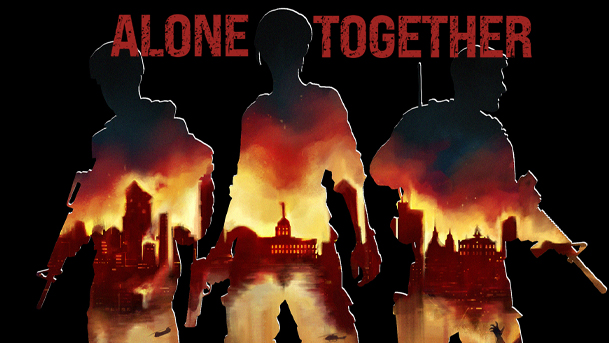
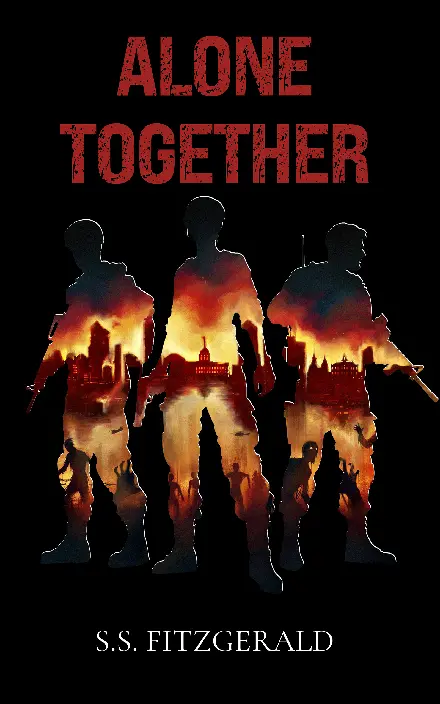
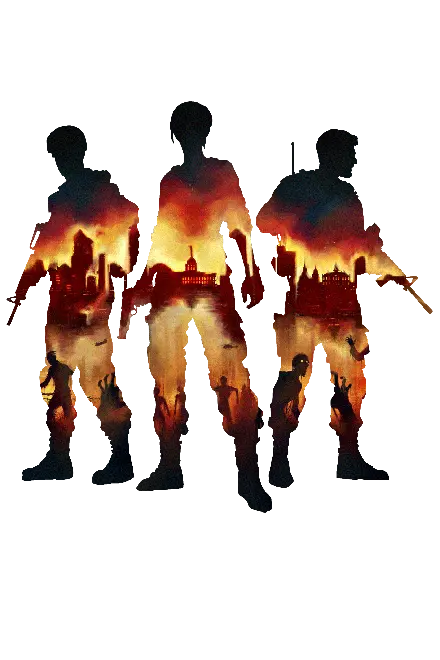
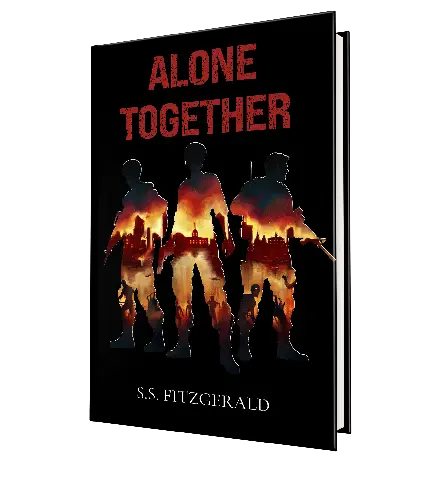
SSF: There’s a saying: “don’t judge a book by the cover,” but we all do it. The artwork I commissioned has absolutely helped me find readers. The cover art for Alone Together captures not just the three central characters, but the city of Tallahassee where the first novel takes place. Art for Alone Together: Factions includes more characters and a climactic event from later in the novel on the cover. Sinner’s Pass I know has readers just because of the cover art. I do not see the visual art as a collaboration that’s shaping the story, but a collaboration in talent communicating ideas between creatives. Seeing an idea come to life in a drawing is extremely satisfying. I learned a lot from my first novel, and I’m dedicated to ensuring the art I use either for cover art, or in promotional material, reflects the ideas I put on paper.
T: I have no doubt that once people realize what a reliable storyteller you are, they’re bound to want to keep tabs on you to determine when the next big S.S. Fitzgerald project is coming out. Do you have a specific spot on the internet that you prefer to steer them toward so that they can be on the lookout?
SSF: Oh boy, it’s easier to list where I’m not than where I am! Jokes aside, my number one resource for readers is my newsletter on Substack. I only post once a month, so it keeps the spam down, but I also announce my giveaways there! I’m on Instagram where I share trailers, and short videos. X (formerly Twitter) and Facebook of course. I also host my website which is where I share all my short stories and link to my works. To make this manageable, you can find my links below and choose which you prefer!
https://linktr.ee/s.s.fitzgerald.writing
T: Shaun, I wanted to thank you once again for taking the time to illuminate the darkness of the worlds that you’ve crafted for fans. It’s always great to see what it takes to bring a world to life, and it’s even more rewarding to get even a little bit into the mind of a creator. I’m hoping that a ton more people find their way to your stories, and that you end up converting them into fans!
SSF: I appreciate your work and thank you for having me. I hope many more come to join my readers of survivors!
T: Folks, one more time, I’d like to thank S. S. Fitzgerald for sharing his time with us and discussing his extensive catalog, both where they are now, and what we can expect in the future. I’d also like to thank him for allowing us behind the curtain, and to see what really makes his process work, and to get just a touch into his psyche. If you enjoyed this interview, and you’d like to jump into his world, make sure you check out Alone Together on Amazon today!


Michael DeAngelo
Latest posts by Michael DeAngelo (see all)
- Historical Fantasy Promo – Crown: Vampire Knights - April 2, 2026
- April Fools 2026 – Ligomorphs – A Transnational Story - April 1, 2026
- Sci-Fi Promo – The Useless: The Last Human Rebellion of the AI Era - March 24, 2026