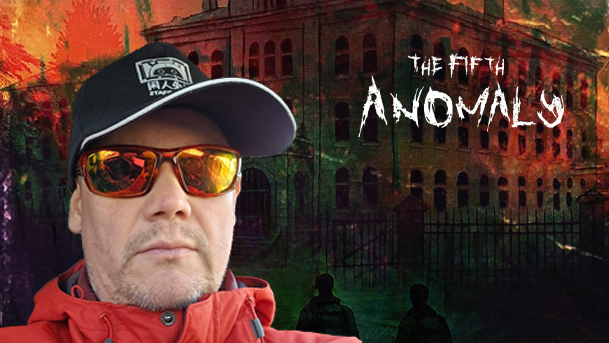
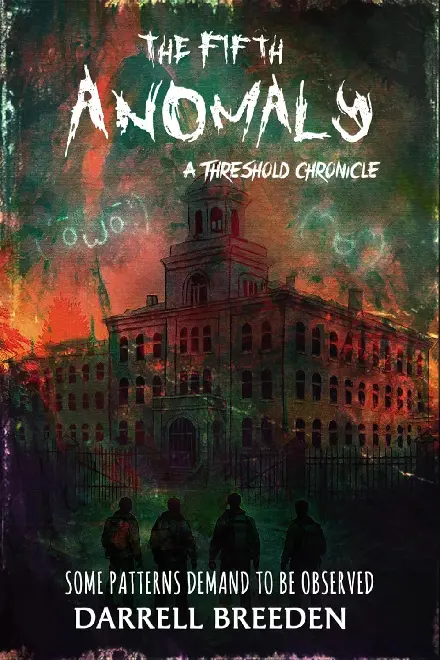
Greetings, travelers. Today, we’re going to be toying with your mind as we look at a horror novel that is a cerebral journey. Along the way, we’ll be talking to its creator, a diligent storyteller named Darrell Breeden, who has an incredible passion for his work that transcends the single book and spreads across a series and beyond. Read on to learn more about The Fifth Anomaly: The Threshold Chronicles (Book 1).
Tellest: Hello there, Darrell! I wanted to start off by offering my appreciation to you for sharing some of your time with us. It’s clear that you have put a lot of yourself into The Fifth Anomaly, and its surrounding world, so I know you must not have an abundance of free time. But I think that passion and drive ends up being seen by fans, and I’m sure you’ll have a lot of them who will enjoy hearing about your creative process and all the supplemental stuff you’ve got going on as we discuss further.
Darrell Breeden: I hope people will love the story as much as I loved writing it!
T: I always start these interviews off with a foundational question that helps readers understand why the authors whose stories they’re reading began writing in the first place. What set you down this path of talespinning? Did you have a favorite writer growing up? Or was there perhaps someone in your family or community who gave you a hunger for fiction?
DB: Dean Koontz was a favorite of mine. An artifact of the 80’s, my parents didn’t really control what I read or had access to. I remember reading Phantoms when I was around 10 years old. At the time it was terrifying, but it taught me a lot about world building. As I got older, I got more into the high fiction space. Read a lot of Tolkien and then got obsessed with Robert Jordan.
T: Do you find that these various genres have sort of helped to coalesce into something that speaks to how you develop your stories now? You have the sort of deep, dark, cosmic horror, along with the generous, rich worldbuilding of fantasy?
DB: Very much. Koontz and Barker taught me what it felt to be unsettled and out of place. Lovecraft taught me what it was like to question my existence. It was Tolkien and Jordan though who gave me a frame of reference for real character development.
T: It is interesting that you landed on them as the final piece, because that is probably the thing I would identify that you do best in your work. Your character development specifically is very nuanced and layered, but the worldbuilding at large is also very rich and immersive. How do you determine how far to go with what you present to your readers? Do you ever feel like sometimes getting to those levels of understanding with your world and your characters can be tough to juggle from a creative standpoint?
DB: Yeah, at some point you have this huge well in your head to pull from but realize that giving it to everyone at once would just drown them. What I’ve kind of come to is “layers of discovery” wherein each part of the story surfaces little granules that layer on top of each other. It leaves an air of mystery but lets the reader infer what they need to.

T: Now let’s dive into The Fifth Anomaly. What was it that made you want to tell this story in particular? Did you have any strong pull toward the horror genre prior to this tale taking shape?
DB: Horror for me is a very direct infatuation. It’s a primal reaction to our instinctual need to survive. Unlike romance, political intrigue, etc., it’s less about the nuances of the buildup of external threads. It’s about shaping a single interaction for a single reaction—one that’s baked into us fundamentally.
T: There are a lot of different ways to craft horror as well, and that sort of transcends mediums in a lot of ways. When it comes to your tales, do you prefer to set up the pieces and make things feel more cerebral and by design, or do you like to twist things abruptly, and surprise your readers?
DB: I like both, which is a major focus of The Fifth Anomaly. It’s a story that seems to be one very specific thing for a large portion of time and then there’s a major twist. Won’t spoil it though.
T: Like all things, finding the balance is an art of its own. For The Fifth Anomaly, did you find that horror balance pretty easily, or did you have to work to find the place where one existed without undermining the other?
DB: For this specific story, it was a bit easier. It’s not a monster story, so most of it is meant to unsettle the reader. The scary part of “cosmic horror” is the truth, which is what the core of the book is.
T: One of the things that elevates your storytelling is that you have expanded media that helps to tell more of the story about what’s happening within the Threshold Chronicles. Was that something you always intended, or was there some sort of inspiration that happened late in the process that convinced you it would help to integrate and enrich your written universe?
DB: That was something I planned on doing for a number of reasons. For one, the book is meant to make you question a lot of things about objective reality, so having some traces of a story in our world is an odd bleed-over effect. It makes you question the story’s place in your world the more you engage with it.
Beyond that, music has an emotional impact that’s very hard to express with prose. Coheed and Cambria is a favorite band of mine, and their albums all follow graphic novels written by the lead singer. I was infatuated with that model as an extension of Keats’ negative capability. Picking one medium or the other leaves a lot of unanswered questions that engages the reader or listener. But taking them both together paints a clearer picture in different spectra.
So, as I wrote the book, I picked out places that had more emotional gravitas and wrote songs for them.
T: Another thing that gives you an interesting perspective within these books is your multicultural background. You know several languages, you’ve got a software-facing brain… There’s a lot going on that gives you a different way of seeing things while you’re writing your stories. What are some advantages you see that you bring to the table for this sort of thing?
DB: From a linguist’s perspective, storytelling is a combination of verbiage and syntax to purvey meaning. In understanding that, it’s an equation, and equations have levers you can pull to modify them.
Lovecraft realized this years ago with liminal mind states. We’re stuck in the dogma of our existence and there’s things we don’t question normally. Sure, gravity is a law. But what if it wasn’t? When you start to think like that, it opens up a lot of world building potential.
T: Sometimes those blessings we have can also be curses. When it comes to those sorts of things, have you ever caught yourself overanalyzing or prioritizing things that you didn’t want to get bogged down in?
DB: Good grief, yes. I would say that’s actually what kept me from finishing a book until now. I was obsessed with building the perfect story, ensuring character integrity, leitmotifs, etc. When I sat down to start The Fifth Anomaly, I valued velocity more than anything. Get the core out and then refine it.
Ironically, it’s similar to the “release early, release often” motto from the open-source software development community. Having a thing matters more than having thoughts about a thing after all.
T: I also find that the speed-based releasing is often what the big names in the industry recommend, and likely what the readership reacts most positively to. Stephen King has famously described telling a story as discovering it like you would a fossil. I suppose he never really make it clear when you switch from the heavy equipment to the toothbrush, but working out all the details after you get the core out is probably a great blend of the two ideals.
DB: I think it’s valuable to both the artist and the reader, but it’s a balancing act. It’s a relief to finish the plot and tell yourself, “Oh I did it,” but recognizing that that’s maybe 20-30% of the work alone can be the painful point. There’s refactoring, plot hygiene, and then full editing. It’s a double-edged sword. You can’t get away from the work, but it lets you essentially do the heavy equipment work first.
T: Speaking of which, even after wrapping up the first draft, going back, doing the triage to your story beats that were shredded, going back, doing formatting, so forth and so on… There’s another component to writing a book, and that is marketing it. Did you already have a notion of what you were going to do to get The Fifth Anomaly in front of people? Or have you had to sort of learn as you go after the book was final draft complete?
DB: I have some ideas. Now that it’s live, I have a KDP ads campaign targeting similar books and categories. I have an application I’ve written to integrate with Claude to give me my summaries from the AWS API daily. I also do ARC Communities like Book Sirens and Book Bounties. I’ll keep an eye on how things go for a month or so and then revisit to see if I need to change anything.
T: With this first book in your Threshold Chronicles wrapped up, where do you see yourself going next? Are you immediately jumping into a second book in the series, or do you have other stories you’re looking to explore?
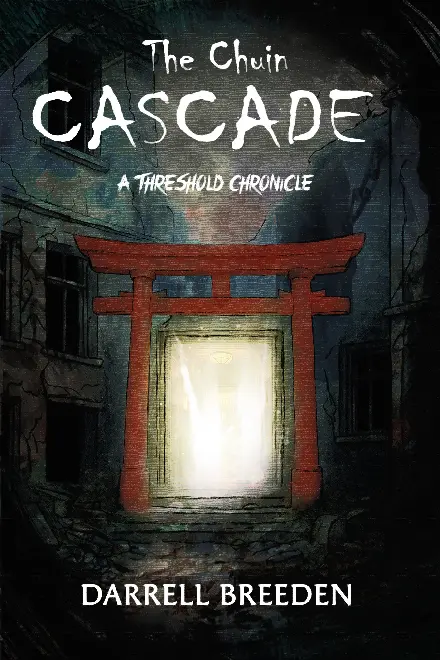
DB: The second book, “The Chuin Cascade”, is already about 80K words done. I’ve still got to add an epilogue for it, but its album is already written and the album for the 3rd book “Echo and Obsidian” was published in early October of 2025. I really want to finish out the story line for this book series before I move on, but I’ve got four more books to write.
The storyline for the entire Threshold Chronicles series is extremely emotional, and I need to tell that story to its completion before I can move onto something else. After that’s done, however, I’m moving into the science fiction space.
T: How would you describe your music, and the way that it intertwines with the literary portions of your project? Do you often have the skeleton of your literary components in place, then write the music, then come back to the story? Or is it a bit more nuanced than that?
DB: I have a very odd approach to this, I think. I use the oral tradition storytelling method in a loop. As I start the story, I’ll tell it to myself over and over again, and in telling myself the story over and over again, the emotional beats really start to coalesce. Those become the foundations for the songs as I’m trying to find the pieces that may translate and hit harder not in prose.
I then sit down and decide on the genre, key, tempo, and major structural components for the music. While I do settle mostly on metal derivatives, the album for the Chuin Cascade is mostly Jazz oriented since it fits the themes of the book better.
T: The same way that stories can take us in strange directions, music that creatives develop can take on a life of their own. Have you ever had one of your tunes flow in a completely different direction than you expected? Did that end up changing the shape of the story it was associated with at all?
DB: Not for the first book since I had already written it out when going back to do the album. The second book’s draft has had a lot of impact from it though. There are entire sections where I went back to the scene, listening to the song trying to maximize the emotional impact. Dialogue and actions beats change accordingly. I have to be careful though. At some point the work has to actually get finished.
T: One of the things that we’re always trying to ensure is that readers and fans can find their way to their new favorite author. If someone reads The Fifth Anomaly and then wants to find out more about you and your stories, where would you direct them? Do you have a website or social media presence that you rely on?
DB: I’m on social media, but not frequently. I do a lot of 3D printing, and painting under the name of Echo and Obsidian studios. There’s also a discord server for the series that I maintain. There’s even an AI agent in the server for the antagonist for the first book for people to interact with.
T: And then you also have that website for the series as well, where people can find the case files, and the methodology and the team, right? Or would you say that’s an antiquated way of enjoying the extra material associated with your series?
DB: That’s a part of the transmedia universe itself. The interesting thing about the https://urbexsociety.net site is that it also includes an AI agent I wrote built around Yomi, one of the antagonists for The Fifth Anomaly. She’s pretty tightly wrangled there, as she’s not allowed to discuss anything but the teams work before they reach Hillrose. The version I have deployed into the discord server doesn’t have the same limitations. Those are all what I consider “bleed over” points, which become way creepier after you read the book.
T: We’re in a world right now that is having a hard time settling on what it thinks of AI. It also doesn’t help that it’s not a one-size-fits-all situation, and AI can be used in many different ways for many different end results. Obviously, you’re using AI as a tool that can enrich your book series. Are there any other nuances about your experience with AI that you think your readers might find interesting?
DB: I work with AI on a regular basis, and one of the characters in the book is an AI, just not in the sense that we are accustomed to now. I think the biggest problem we have now is that our society is in an over-reactionary state for AI.
Claire Obscur: Expedition 33 was recently stripped of its Indie Games Game of the Year Award just because they used a single AI Generated texture. I feel like we need to realize AI is here to stay at some point and start having nuanced discussions about it. I doubt you’ll find many creatives that aren’t using it in some way.
T: Darrell, I wanted to thank you once again for sharing some of your time with me and your readers. It’s clear that you’ve got a tremendous amount of work that you’ve set up for yourself, and it was a joy to be able to see bits and pieces of that process. I wish you luck as you work on the rest of your series and beyond!
DB: Thank you once again for your time, and I wish you luck in your endeavors as well!
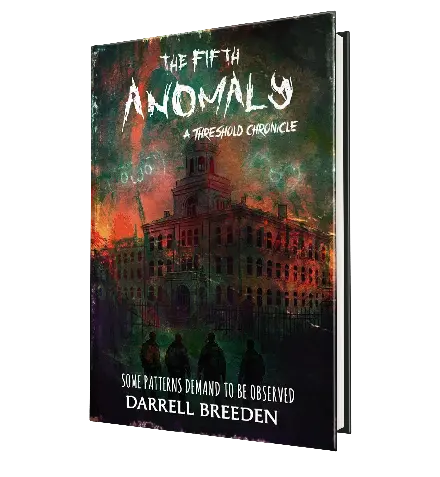
T: I’d like to once again extend my gratitude to Darrell Breeden for the time he has given for this interview, and for allowing us to take a peek behind the curtain so that we can see his process and what we can expect coming soon. It is always a great opportunity when we get to see into the sort of mental workshops that creatives play in, and this was absolutely no exception. I hope you enjoyed this conversation with Breeden. Be sure to check out The Fifth Anomaly: The Threshold Chronicles (Book 1) on Amazon today!


Michael DeAngelo
Latest posts by Michael DeAngelo (see all)
- Sci-fi Promo – Starbreaker Protocol - April 10, 2026
- Historical Fantasy Promo – Crown: Vampire Knights - April 2, 2026
- April Fools 2026 – Ligomorphs – A Transnational Story - April 1, 2026