
Greetings, travelers. In our trip through the Otherworld today, we’re going to be spending some time in the world of Tallaria, a creation passionately crafted by author Charlie Davis, whose book Souls of Fate: The Paladin’s Rebirth has recently released on virtual storefronts. Read on to learn more about this story, and about Davis’s process in bringing it into this world.
Tellest: Hello there, Charlie! First off, I wanted to thank you for sharing your time with me when it comes to your new book and your writing process. I scoured the internet and discovered just how enthusiastic you are about your book, and the growing series it seems you’ll be building out from it. This doesn’t feel like something that was scraped together in pieces, but something that you took ardent interest in, and you can tell you put a great deal of yourself into Souls of Fate. I’m looking forward to getting to know you a bit more, and to open the door a bit wider to readers and fans.
Charlie Davis: Hi, thanks for having me! I’ve always been a lover of fantasy—TV shows, movies, video games, etc. Since I was a young boy, I’ve come up with ideas of how I’d like to see a fantasy story of my own to be. I even wrote short stories over the years, and it helped me get a little experience in writing. I fell out of love with writing for several years but making my own story was always on my mind and finally I decided if I didn’t do it, I would regret it someday.
T: The bedrock of these interviews is always set in stone when we try to figure out where our storytellers were first touched by the spark of inspiration. When you were growing up, did you have a certain author that you were a tremendous fan of? Or did you have some other media that gave you this interest for speculative fiction content?
CD: I’m a big fan of J.R.R. Tolkien and R.A. Salvatore. Their books have always been an inspiration to me.

T: Both of those authors that you’ve mentioned have left indelible marks on the fantasy genre, and though they’re decades apart from when they were in their primes, Salvatore does lean on some of the tropes that Tolkien engrained within fantasy. One of my favorites is the, “if there’s no body, the character isn’t dead” trope. Do you ascribe to that sort of thing within your series? Or do you have another fantasy trope that you enjoy seeing in your favorite books and shows?
CD: I think characters Jon Snow and Tyrion Lannister from Game of Thrones are often my favorite types. Although very different in many ways they are the same at that time—outcasts and often hated, but they often shine in the show. Jon Snow often in all black, with a mysterious past, wielding an awesome sword, who is a leader, and gets two of the best-looking ladies in the show/book. What’s not to like? Tyrion Lannister, however, we know about his birth and how he’s hated. Sadly, he has to buy love and drinks his life away to forget his pain of his past and present. Tyrion is brilliant, however, and cares more about the people important to him. The outcasts often make the best characters. Like Drizzt Do’Urden: rejected by his people and much of the outside world because of the reputation of the Drow. He is hated. He’s struggled, yet often saves the day with the many friends he’s met over the years. The main character Eli in my book is much like this. Wanting to do what’s right but wanting the pain to go away and live a peaceful life.
T: Now, those are characters who are largely looked at through a positive light. Who are the kind of villains that you enjoy, even if that’s just liking that you hate them so much?
CD: Villians like Joffrey Bartheon and Ramsey Bolton are the types of villians I love to hate—ones that are arrogant, cruel, and simply evil to be evil. It’s not often that I hate anyone in a book, game, or movie but those guys… Wow!
T: Next, I’d like to talk more about Souls of Fate. This is your debut book, but from the experience I’ve had reading it, it was not something that you raced to the finish line. You can tell that careful planning and execution was utilized throughout its inception to its release, and it really is an impressive debut. There’s incredible character growth, rich worldbuilding, and, from a technical standpoint, a lot of experience on hand for someone who is just releasing their first story.
How did this story come to you and let you know it wanted to be told? And how did you come to an understanding of what you needed to do in order to give it the best chance to shine? Was it just from your experience absorbing other books, or did you have resources you could lean on who were able to direct you and position you for a great launch?
CD: I want to give my readers quality, not quantity, from reading my work, so I made sure it would be something that I didn’t only want to read but to get lost in. Much of it is loosely based on my own life and what I went through along with some of the people I met. As I mentioned, I’ve always loved fantasy and, going over the events of my life in my mind, fantasy always managed to merge with these experiences.
T: Since most writers begin by writing what they know, they end up tapping that pool until it runs dry, and they end up expanding outward, whether through research or just as far as their imagination can take them. When you’re thinking of other books you’d like to write, are you interested in crafting something from the bottom up, or do you like building on something that already has a foundation, like within historical fiction?
CD: I sometimes build my ideas from others but craft them into something that makes it mine. Such as dragons, elves, dwarves, etc. You’ll see more of those creatures in future books but they’ll be different than everyone else’s, I promise! I do like to write about things as well that no one else has done and I often carry a notebook with me. Ideas sometimes come to me like getting hit by a bolt of lightning and I’m like I HAVE to write that down or I’ll forget!
T: A lot of what we’ve identified that you enjoy are these really robust fantasy worlds. Tolkien’s Middle Earth is so huge that he had to build all these appendices to make sense of it all. Game of Thrones, as everyone knows, is crowded with so many places and people, and history that it’s hard to make sense of it all. And Salvatore’s books are part of the grand tapestry of the D&D universe. Do you aspire to make your series that rich and robust, or are you happy to have a more personal lens on Eli and his friends?
CD: I’d like to hopefully expand my horizons a little bit in future novels. It’s like putting puzzle pieces together, finding out where it all belongs and making a picture. The more pieces you have, the more difficult the puzzle can be. Hopefully, in time, I can make a beautiful picture for the world to see and admire.
T: Earlier, you mentioned enjoying fantasy in various mediums. With a book already under your belt, have you ever imagined seeing your work reimagined in another medium? Would Souls of Fate work well as a show or a video game?
CD: I would LOVE to see that happen! I’ve been a gamer since I was 8 years old and I wanted my story to be game as well. A show would be awesome too. I hope to see this come true!
T: We talked about the movies and shows you liked earlier, but what kind of games help to spark imagination and creativity in you?
CD: The Dragon Quest series is a big one. I’ve been a fan since I was 9 years old and have been playing all these years. Elder Scrolls Oblivion and Skyrim, Chrono Trigger, Witcher 3: The Wild Hunt, and the Final Fantasy games (mostly the older ones).
T: This book doesn’t shy away from using faith and religion as core tenets of the story. But rather than using it as a crutch, as something to lean on, it uses it as an effective tool. It feels like something that adds to the immersion instead of breaking it. Did you have any difficulty hitting that balance, or was it something that flowed easily for you?
CD: It was rather easy for me. Being a religious man myself, I wanted to show how even people who believe in a higher power aren’t perfect and struggle sometimes.
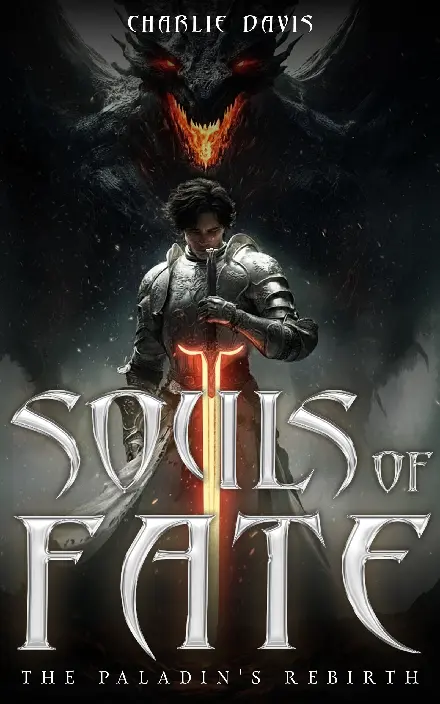
T: And your paladin doesn’t have just a small misstep, but a weighty clash with his faith. In a lot of ways, we’re seeing Eli close to rock bottom. Was it a challenge working with a character who was so scarred by his experiences?
CD: It really wasn’t. Eli’s past is loosely based on my own experiences with faith. To often see the worst in the people who claimed to be the best is a horrible experience while wondering what the heck happened.
T: So, from a technical standpoint, it’s easy to tell the story, because it’s one you have experience with. But was it hard to bring up past experiences that may have left negative thoughts in their wake that you had to relive? Or have you mostly made your way past them in a healthy way by this point?
CD: I’ve made peace with most of what happened, but they definitely left scars. Sometimes I might feel something negative, but the memories have made me stronger, more careful, and able to tell my story in a way that I think some people can learn from what I went through.
T: One of the things that I’ve learned about you while I was researching you and your book, is that you’re the kind of person who doesn’t just look for encouragement but also wants to make sure that other people are successful and poised for their small victories as well. How do you feel the sort of writers’ groups help storytellers when they band together? And what are some bits of advice that you could offer to new writers who are starting down their own path in a way that you once did?
CD: I think it’s always good to get advice and help from others. However, you can get all the advice in the world and still not be sure how to go. Sometimes you just need to just dive in! Begin writing, do your research, ask for help, etc., but get moving. I was writing short stories when I was 12 and I finally decided at 46 to get my first book published.
T: They do say that starting is the hardest part. What advice would you give to people who wanted to put pencil to page for the first time? Is it less about getting it right, and more about just getting it down?
CD: It’s more about just getting it down and correcting the things you want to change later. Building the foundation is the hardest part. You might change the story a hundred times and that’s okay, but write, make notes, take a break when you need to, but worry about getting it right later.
T: When you’re telling your story, do you have a pretty firm grip on what’s going on and who is doing what? Or have you had instances where your characters have surprised you with what they want to do and how they react to thing?
CD: Since most of my characters are based on people I knew in real life, not much surprises me since I knew most of them real well, and this is how I see them personally. But even those that you think you know most can throw a surprise or two!
T: While Souls of Fate seems fairly self-contained, Tallaria feels so rich and deep that I can’t imagine you leave this world behind. Do you see yourself coming back to tell more stories in this universe?
CD: I would like to write at least 4 more stories. As our heroes grow, so do their enemies and there’s plenty to tell about what might happen next.
T: Do you ever get the subconscious pull from your characters to tell a side story with them as the focus? You mentioned earlier that you’ve explored short stories as well. Could something like that add even more layers and texture to your world?
CD: I think life experiences often tell the best stories. One of my coworkers who will have a character based on him in the next book told me about a story concerning him and his grandfather. I told him I was adding it in the next book, and he nearly broke down in tears and thanked me for remembering him telling me that.
T: It is nice to be appreciated for those sorts of things. Have you ever wanted to eviscerate someone in fiction who wronged you?
CD: A few but I think their time will come. Those that like to hurt people and keep practicing it will get there’s someday.

T: I feel this question needs to be asked of you, as you seem like you might be the foremost expert on the question. Who would win in a fight: Geralt of Rivia, Bruce Wayne, or Drizzt Do’urden? Let’s assume each of them is dropped in an unfamiliar area, without immediate access to their belongings.
CD: Oh, I know all about those guys! Tough call on that one but I do know none of them would be walking away without a scratch!
T: If a reader were to find you and absolutely love your book, where could they go to find new information about you? Do you have a website or a social media handle that you would direct them to?
CD: I’m working on that. I’ve been doing so much in such a short time I had to push myself away from everything because I’ll get a little burnt out. I work a fulltime job as well so it’s hard not to get overwhelmed sometimes.
T: Among many of the creative types I work with, we end up saying that creativity is seasonal. You’re not always going to be in the right mindset to work on the same project nonstop forever. In a way, you’re finding out how to best recharge. But when you’re not working or writing in this world, what other things are you doing to satisfy that creative hunger?
CD: Trying to get creative ideas from your brain all the time is like sometimes trying to eat from an empty bowl or dinner plate. It’s not always going to have something on it or in it. Rest that brain of yours. I often read, play a video game, listen to music, spend time with family, etc. Once your brain relaxes and gets enough rest an idea or two might hit you unexpectedly.
T: Charlie, I wanted to thank you once again for taking some of your time to chat with me about your book, and your process. I thoroughly enjoy getting to know storytellers better, and I’m sure that as people read Souls of Fate, they’re going to be excited to know that there’s an article that helps draw back the curtain a little bit. I wish you luck now that this book is out, and I’m eager to hear more from you when the sequel is ready to drop!
CD: Thank you! I enjoyed it! I’m already taking notes, things are taking shape, and hopefully the next Souls of Fate book will be out before you know it!
T: Folks, I wanted to express my gratitude to Charlie Davis one more time for letting us see all the machinations of his process, and to give us an idea of just how his inspirations lead to the books that he’s writing. It’s always a great joy being able to see these things take shape. If you’re interested in reading Davis’s debut, check out Souls of Fate: The Paladin’s Rebirth on Amazon today. And sit tight while the next book takes form!
If you’re looking for the trailer, you can see it below:


Michael DeAngelo
Latest posts by Michael DeAngelo (see all)
- Sci-fi Promo – Starbreaker Protocol - April 10, 2026
- Historical Fantasy Promo – Crown: Vampire Knights - April 2, 2026
- April Fools 2026 – Ligomorphs – A Transnational Story - April 1, 2026